
By The Angry Video Guy
I've shot a lot of commercials in my career. Automotive. Legal. Healthcare. Retail. And after 25 years doing commercial video production in the Hudson Valley and across the NY Tri-State area, I can tell you with complete confidence that nothing exposes the difference between a competent production and a lazy one faster than food.
Food is unforgiving on camera. Either it looks like something you'd drive across town for at 9pm on a Wednesday, or it looks like a photo from a 1987 Denny's menu that got left in a hot car. There is no middle ground. And yet, flip through your local cable channels on any given evening and you will find restaurant commercials that make the food look like something you wouldn’t want to eat…which seems like the opposite of what the commercial SHOULD be showing.
Let's talk about why this keeps happening, what it actually takes to shoot food that makes people hungry, and while we're at it, a few other things that restaurant owners are getting wrong that have nothing to do with video production.
Shooting Food Is a Skill. Treat It Like One.
There is a reason that food cinematographers and food stylists exist as dedicated professions. These are people who spend their entire careers doing nothing but making food look extraordinary on camera, and they stay very busy and are expensive. Because it is genuinely hard.
Lighting food is completely different from lighting a person or a location. The wrong lighting and your perfectly plated pasta looks flat and grey. The wrong color temperature and your steak looks like something from a crime scene. Shadows fall in the wrong place and your gorgeous dessert looks like it was shot in a basement. Getting it right requires experience, the right equipment, and the patience to actually take the time. This is not something you hand off to whoever is available with a camera and a ring light. If your food doesn't look extraordinary on screen, you haven't made a commercial. You've made a reason for people to eat somewhere else. Yikes.
Stop Filming People Eating. Seriously, Stop.
I need to address something that has been bothering me for years.
Why do so many restaurant commercials insist on showing people chewing?
Nobody wants to watch strangers eat. Nobody. You know who wants to watch strangers eat? Nobody (I don’t even think there’s any weird fetishes for that, but let’s assume there’s not…please). And…I’m guessing that most people don’t like to be filmed while they’re eating either. The entire premise is flawed from the jump, and yet there is an entire genre of local restaurant advertising built around tight shots of restaurant patrons shoveling food into their mouths with exaggerated expressions of joy. Yuck.
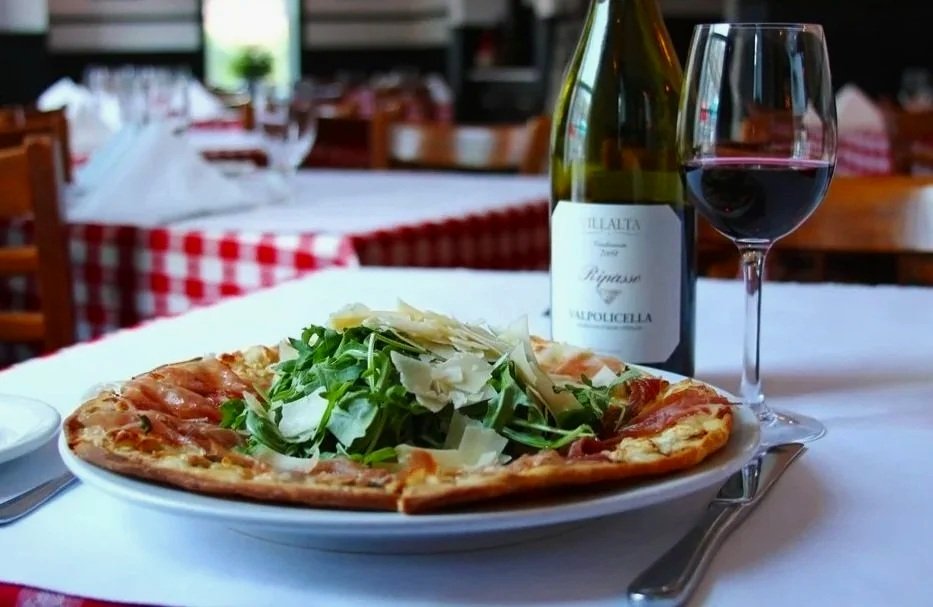
A good restaurant commercial shows the restaurant, the atmosphere, the energy of the space. It shows beautiful food: the pour of a sauce, the char on a piece of meat, steam rising from a fresh plate, a wine glass being filled, a dessert arriving at the table. It shows people having a great time, laughing, being served, lifting a glass. That's what you want and what people want to see. Not the next fifteen seconds of the chewing that follows.
Show me why I want to be in that room. Show me the food I'm going to eat. Do not show me what happens after.
The Right Way to Shoot a Restaurant Commercial
Here is something that should be obvious but apparently isn't: do not shoot your commercial during a busy dinner service.
I have seen this attempted. It is chaos. Your staff is distracted. Your customers didn't sign up to be in a commercial and most of them will make that very clear. The lighting is whatever the restaurant has installed, which almost certainly was not designed for video production. And the video crew, even if it’s a small one, will be in everyone's way.
The right approach is to book a production day when the restaurant is closed, or at least early in the day before you’re open. Full control of the space, the lighting, the timing. You can set up properly, shoot the food the way it deserves to be shot, and get the location footage you need without disrupting anyone.
For the people shots, invite a small group. Family, close friends, your best regulars who you know are photogenic and would genuinely enjoy being part of it. Keep the group small, keep it relaxed, and let them actually have a good time rather than directing them into stiff posed shots. Authentic energy reads on camera. Forced smiling does not.
One more thing worth knowing: the same production day that gives you your TV commercial also gives you the footage for a beautiful background video loop to be used on your website and social media. Same look, same quality, same visual identity across every platform. That food video production happens in one day, gives your website a polished, professional feel, and creates consistent branding between your restaurant marketing video and your online presence. That kind of consistency doesn't happen by accident, and it doesn't require a second production budget.
Where Your Commercial Should Actually Run
Once you have a commercial worth airing, don't make the mistake of only throwing it at a broad cable buy and hoping for the best.
Streaming platforms like Hulu, Roku, YouTube and the broader connected TV ecosystem let you target households by zip code, by time of day, by demographics, by interest categories. A restaurant in Westchester, Long Island, or anywhere in the Hudson Valley can serve ads specifically to households within a ten-mile radius during the hours when people are deciding where to eat dinner. That is a fundamentally different proposition from buying a cable spot that airs at 2pm to the entire tri-state area.
And here's something specific to restaurants that's worth thinking about: the people searching for a place to eat right now are not casually browsing. They're hungry. They've already decided they want to go out. Your commercial showing up on their living room TV while they're planning their evening is about as well-timed as advertising gets.
Put a QR code in the commercial that goes directly to your menu or your reservation page. Someone sees your food looking incredible on their TV, picks up their phone, scans the code, and they're looking at your menu in ten seconds. That's not a conversion funnel. That's a direct line from their couch to your table.
And if you serve a community with significant Spanish, Chinese, Korean, or other language-speaking populations, consider the fact that those households are being largely ignored by most local restaurant advertisers. Multilingual commercial production targeting specific language-preference households through streaming platforms is one of the most cost-effective and underused advantages in local advertising right now. People who speak different languages need to eat too, and they tend to be very loyal to businesses that speak to them directly.
While We're At It: Please Fix Your Digital Presence
Since we're already here and I'm already worked up, let me address a few things that aren't strictly about commercial production but are absolutely killing restaurants that otherwise have great food and great service.
Your website menu. I should not have to squint at a photo of your menu taken on someone's iPhone from three years ago, I should not have to download a PDF that was clearly scanned upside down in 2019. Your menu is the single most important piece of information a potential customer needs before they decide to come in. If I can't find it and read it easily on my phone in under ten seconds, there's a solid chance I'm going to the place down the street whose menu loads instantly.
Online reservations and ordering. If I have to call you to make a reservation in 2026, we may have a problem. OpenTable, Resy, a simple form, whatever works for your operation. Just make it easy. Same goes for takeout ordering if that's something you offer. An easy, reliable online ordering system is not a luxury feature. It's a basic expectation and not having it may very well cost you customers.
Your Google Business profile. This is where a lot of restaurant customers find you first, especially people who are already out and looking for somewhere to eat nearby. A well-produced video on your Google Business profile and your Yelp page shows up in search results and immediately sets you apart from competitors who have nothing but a few phone photos. Someone searching "Italian restaurant near me" sees a thumbnail of beautiful food and a well-lit dining room in your listing. That is a competitive advantage that costs you nothing extra once the commercial is produced.
The Bottom Line
A great restaurant commercial does one job: it makes someone want to be sitting at one of your tables right now. It makes them hungry. It makes them want the experience. It makes the decision easy.
A bad restaurant commercial, the ones with flat lighting, unflattering food shots, and people chewing enthusiastically at the camera, does the opposite. If it catches anyone’s attention, it’s not necessarily for the right reasons. And in a business where you're competing against a dozen other options within walking distance, doubt is the last thing you can afford.
Unlike a bad lawyer commercial, which can still work because one big case pays for everything and people call when they're desperate regardless of production quality (we've covered that phenomenon separately), a bad restaurant commercial is actively working against you. Nobody walks into a restaurant thinking "well the commercial looked terrible, but let's give it a shot." The food has to look good before they walk in the door. That's the whole game.
Get the production right, get it on the right platforms, and make it easy for people to act on what they just saw. The rest takes care of itself.
See more of our food samples here.
About the Author:
The Angry Video Guy is the alter ego of Mike Meyerson, founder of Absolute Motion, a commercial video production company based in Mahopac, NY, serving restaurants and businesses throughout the Hudson Valley and NY Tri-State area for over 25 years. He has strong opinions about food lighting and will not apologize for any of them. Read more from The Angry Video Guy.
